

i don’t keep secrets?
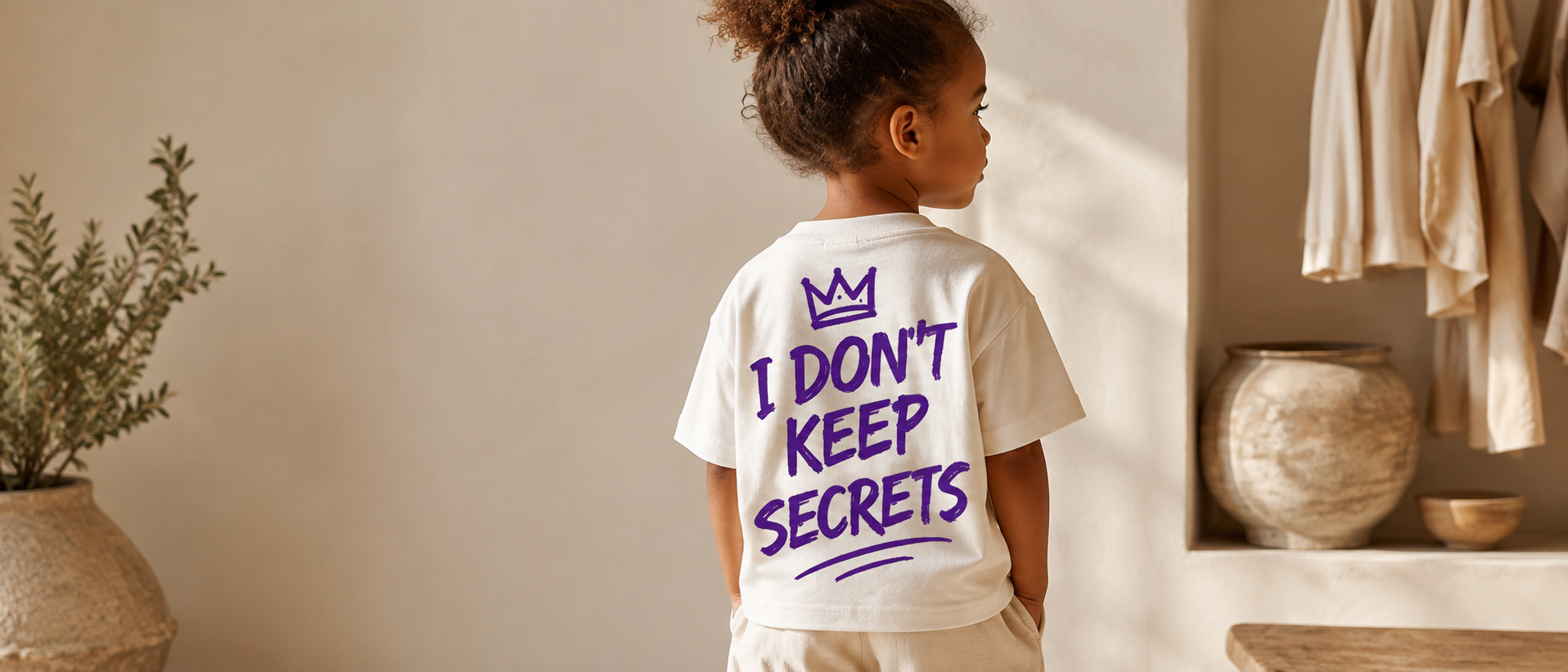
When people first see one of our T-shirts that says "I Don't Keep Secrets," they usually smile.
Then they stop.
They ask questions.
And that's exactly the point.
At MALA & CO, we believe clothing can be more than something our children wear. It can become a conversation starter. A reminder. A message they hear so often that it becomes part of how they understand themselves and the world around them.
As a mother, educator and presenter with Grooming Recognition, I've spent years learning about child safety, grooming behaviours and the protective factors that help children grow up safer, more confident and better equipped to recognise when something doesn't feel right.
One thing I've learned is this:
Children don't need to grow up afraid. They need to grow up informed.
Why these conversations matter
The reality is that child sexual abuse is far more common than many people realise.
Research from the Australian Bureau of Statistics found that around 1 in 7 Australian adults experienced physical or sexual abuse during childhood, and more than 1 in 5 experienced childhood abuse and/or witnessed violence between parents before the age of 15.
In New Zealand, organisations supporting survivors note that 1 in 10 boys experience sexual abuse before the age of 16, and internationally it is estimated that around 1 in 4 girls experience childhood sexual abuse. They also highlight that more than 30% of confirmed reports of child sexual abuse involve boys, reminding us that child sexual abuse affects children of every gender.
These statistics are difficult to read.
But they remind us why education, awareness and trusted relationships matter.
Safe adults don't ask children to keep unsafe secrets
One of the most common tactics used by offenders is secrecy.
Children may hear things like:
"This is our little secret."
"Don't tell Mum."
"You'll get me into trouble."
"No one will believe you."
"This is special between us."
These are not harmless secrets.
They are unsafe secrets.
One of the simplest protective messages we can teach children is:
Safe adults never ask children to keep unsafe secrets.
Instead, safe adults encourage children to ask questions, tell the truth and speak to another trusted adult whenever something doesn't feel right.
What's the difference between a secret and a surprise?
This is one of the conversations we encourage every family to have.
A surprise
A surprise makes people feel excited.
It has an ending.
Eventually everyone gets to know.
Examples include:
A birthday present.
A surprise party.
A handmade Mother's Day card.
Surprises are temporary.
A secret
An unsafe secret asks a child to hide something that could make them feel worried, confused, scared or uncomfortable.
Unsafe secrets often make children feel like they can't tell anyone.
Those are the secrets children should always share with a trusted adult.
A simple way to explain it is:
Surprises are fun because everyone finds out. Unsafe secrets are never meant to stay hidden.
Why we created our T-shirts
Our shirts aren't designed to scare children.
They're designed to empower them.
Messages like:
I Don't Keep Secrets
Safe. Seen. Heard.
Loved Loudly.
Fiercely Protected.
are gentle reminders that children deserve to be listened to, believed and supported.
They also create opportunities for parents, grandparents, teachers and caregivers to ask simple questions:
"What do you think that means?"
"Who are your safe adults?"
"What would you do if someone asked you to keep a secret?"
Sometimes those conversations last two minutes.
Sometimes they become the conversations a child remembers for the rest of their life.
Protection begins long before something goes wrong
At MALA & CO, we believe it should be lived with confidence.
Confidence to trust your instincts.
Confidence to know your body belongs to you.
Confidence to know you can always talk to a trusted adult.
Confidence to know you will be listened to.
Because sometimes the most powerful form of protection isn't found in a rule or a lesson.
It's found in thousands of small conversations that tell a child:
You are safe.
You are seen.
You are heard.
And your voice matters.